




Many students and parents in China hear the same advice when planning Australian study pathways: “This major is good for migration — you can just go for the 189.”But the reality is: the 189 visa is no longer an era where you can study anything and simply compete on points.Today’s 189 Skilled Independent visa has entered a critical phase — the occupation Tier era.
I. Why Do Some Applicants Have High Points but Still Never Receive a 189 Invitation?
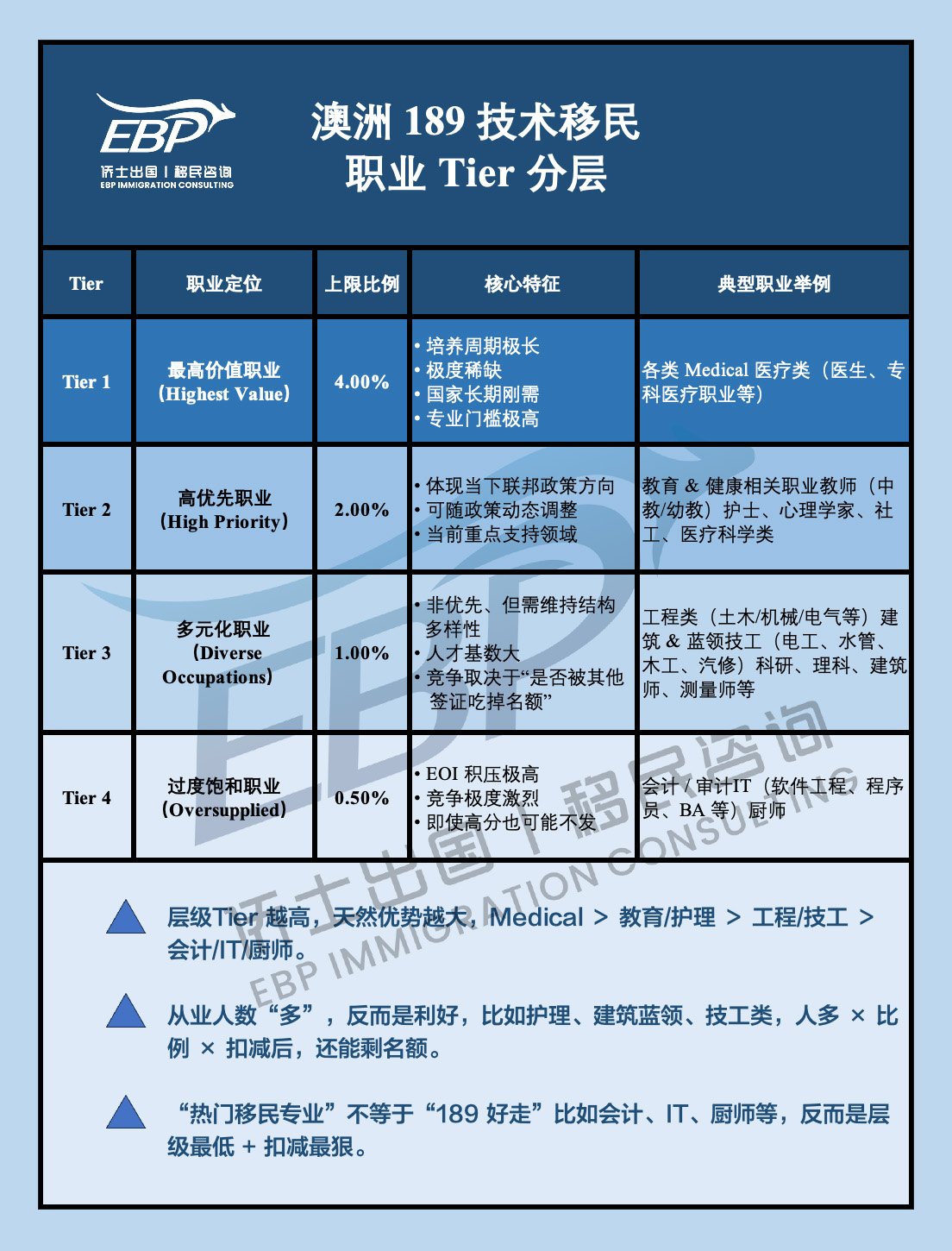
Because the logic of the 189 visa has fundamentally changed:First, the occupation is assessed. Only then are points considered.Australia classifies all occupations into different Tiers based on national shortage levels and long-term value. And the difference in invitation chances between Tiers is huge.
II. The Four Occupation Tiers of the 189 — You Must See Them Clearly
Tier 1 | Nationally Scarce, Highest-Value Occupations
Characteristics:
- Extremely long training pathways
- Very low substitutability
- Long-term national demand in Australia
Typical examples:
- Doctors
- Medical and healthcare-related professions
Realistic conclusion: These occupations are not about “whether migration is easy” — Australia needs them badly enough that it has no choice.
Tier 2 | Policy-Priority Occupations Actively Supported by the Government
Characteristics:
- Clearly aligned with current Australian policy directions
- Expected to remain priority areas for the coming years
- Manageable competition and relatively stable success rates
Typical examples:
- Education (Secondary Teachers / Early Childhood Teachers)
- Nurses
- Psychology
- Social Work
- Medical science–related majors
Realistic conclusion: This is the most worthwhile migration pathway for ordinary families to seriously consider.
Tier 3 | Not a Priority, but Still With Opportunities
Characteristics:
- Large number of practitioners
- Needed by the country, but not urgently
- Invitations depend on whether there are “remaining places”
Typical examples:
- Engineering (Mechanical / Electrical / Civil, etc.)
- Construction-related occupations
- Skilled trades (Electricians, Plumbers, Carpenters, Motor Mechanics)
- Research and science fields
- Architects, Surveyors
Realistic conclusion: It’s not impossible — but you must be prepared for time and uncertainty.
Tier 4 | Severely Oversupplied and the Least Friendly Occupations
Characteristics:
- Extremely high number of applicants
- Very limited invitation places
- Even high scores may still lead to years without invitations
Typical examples:
- Accounting
- IT (Software Engineering, Programmers, Business Analysts, etc.)
- Chefs
Realistic conclusion: These are the most heavily promoted majors in China — but the hardest pathways under the 189.
III. Three Common Pitfalls for Chinese Families
Pitfall 1:Believing that “popular majors = good for migration.”
- Popular ≠ in shortage
- The more people study it, the fiercer the competition
- Accounting, IT, and Chefs are the most typical counterexamples.
Pitfall 2:Only looking at points, not occupation Tier.Many families ask: “Can my child reach 90 points?”But the real question is: Is this occupation even prioritised for invitations?Without Tier advantage, points are just numbers.
Pitfall 3:Assuming “fewer people = easier migration.”In reality:
- Some occupations have fewer people
- What is truly safer are occupations with large numbers AND large national demand, such as nursing, education, and construction trades.
What is truly safer are occupations with large numbers AND large national demand, such as nursing, education, and construction trades.
IV. Practical Advice for Students in China,If your goal is “study in Australia + a future chance at permanent residency,” remember these points:
- Choose the right occupation first, then choose the school
- Don’t be misled by “good employment prospects” or “popular majors”
- The 189 visa has never been evenly distributed
In Australia, what the country needs you to do matters more than what you want to do.