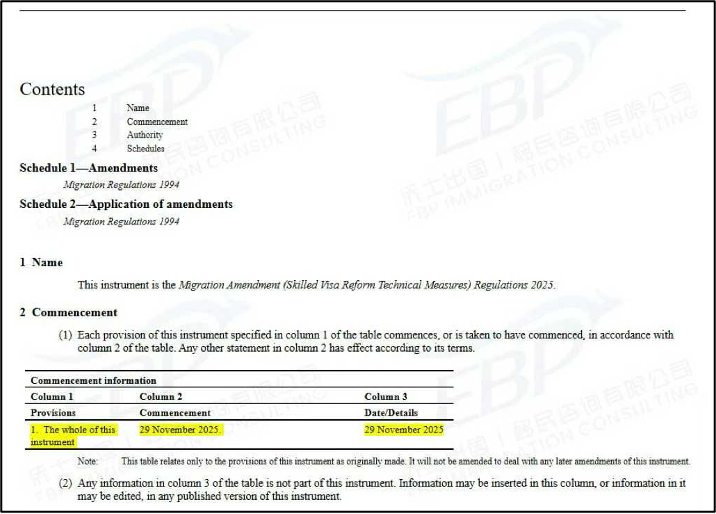
Australia’s Department of Home Affairs has officially implemented the Migration Amendment (Skilled Visa Reform Technical Measures) Regulations 2025. This reform is considered the most important upgrade to the employer-sponsored visa system in nearly a decade:
- Clearer PR pathway from 482 → 186
- Higher success rate for onshore applicants
- Lower employer-sponsorship risk, more stable procedures
- A strong alternative + stable PR pathway compared with highly competitive points-tested visas
1. Four Key New Measures (All Already in Effect)
- 482 SID refusals can now apply for AAT merits review (already effective)
Before 29 November:
✖ If an offshore applicant was refused → basically no review rights
✖ Extremely high risk
After the reform:
✔ SID (Skills in Demand) refusals → can apply for AAT Merits Review
✔ Provides more protection to applicants
✔ Huge advantage for offshore applicants
✔ Improves overall transparency and fairness
- Old and new 482 systems are now fully unified (already effective)
After the reform:
✔ Standardised processing logic
✔ Clear rights and obligations
✔ Clear compliance requirements
✔ Reduced employer-sponsorship risk
Meaning for applicants: employers are more willing to sponsor long-term, compliant employees.
- Most important: 186 TRT PR pathway requirements are now written into legislation (already effective)
The new regulations clarify that the 2 years of full-time experience required for 186 TRT must be completed under an “Approved Work Sponsor.” This means the experience must meet:
- The employer holds a valid SBS (Standard Business Sponsor)
- No gaps or lapses in sponsorship status during employment
- Work performed for a non-approved sponsor → not counted
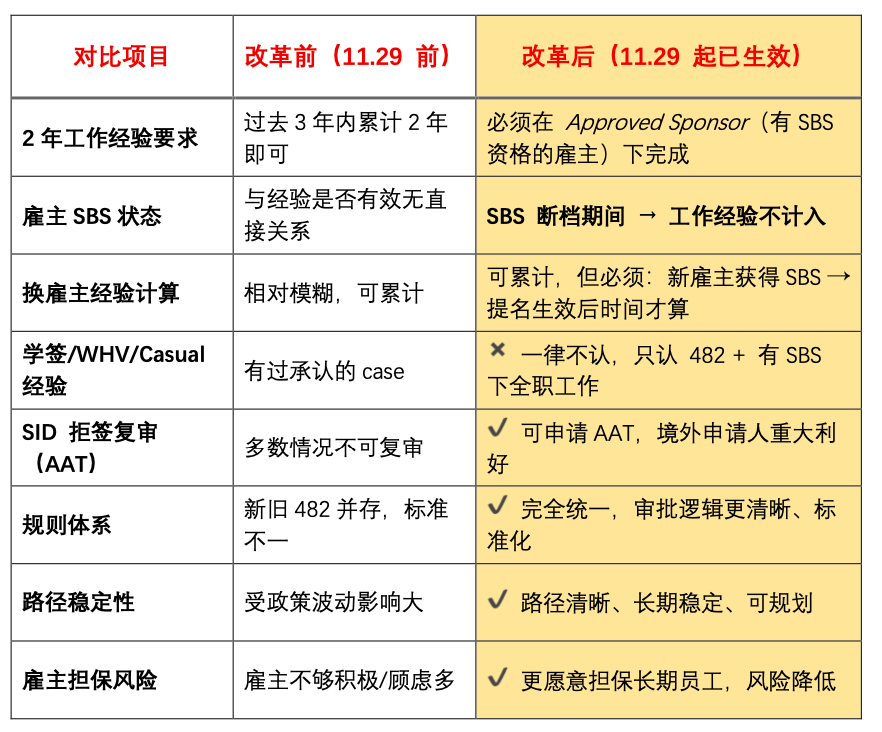
2. Before vs After Reform (All now operating under new rules)
Before the reform (no longer applicable):482 holders could apply for 186 TRT after accumulating 2 years of experience within the past 3 years. Whether the employer’s SBS was valid did not affect whether the experience counted.
After the reform (now effective):The 2 years must be valid, compliant, continuous experience, meaning:
✔ Completed entirely within the SBS validity period
✖ Work performed while the SBS was expired → not counted
✖ Experience cannot be “mixed,” “blended,” or vaguely calculated
3. Employer SBS status is more important than ever (now legally required)
Under the new regulations, once an employer’s SBS expires:
- SBS must be renewed on time
- High-turnover industries (hospitality, care, chain businesses) often “forget to renew”
- Any lapse → employees cannot accumulate valid experience
The reform allows changing employers and still accumulating experience, but only if:
- The new employer has obtained SBS
- The switch occurs within the legal 180-day bridging period
- Only work performed after the new employer has SBS counts as valid experience
4. Changing employers (new rules clarified)
新规允许:换雇主仍可累计。但需满足:换雇主可以,但必须合规、时间点不能乱。
- The new employer has obtained SBS
- The switch occurs within the legal 180-day bridging period
- Only work performed after the new employer has SBS counts as valid experience
5. Why onshore applicants now benefit the most?
Because the new regulations clearly favour real, ongoing employees already working in Australia:
- Real employment relationships → employers more willing to sponsor
- SID refusals can be reviewed → much stronger protection
- Employer compliance requirements are stricter but create a more stable pathway for long-term employees
- 2years on a 482 → direct 186 PR
You do NOT need:
✖ 分数
✖ 技术移民 EOI 排队
✖ 高分语言
✖ 学历加分
✖ 职业配额竞争
只需满足:
✔ 年龄 <45
✔ Approved Sponsor
✔ 2年合规全职工作经验
6. Two Things You Must Do Now (Extremely Important)
1. Immediately check whether your employer’s SBS is valid!If SBS expires, your experience becomes “wasted.” Especially if:It expires within the next 6 months.The company has not proactively checked.Your industry commonly forgets renewals.
2. Confirm whether your work experience counts as “valid experience.”Avoid situations where continuous work does not count because:SBS lapsed.You changed employers but nomination was not submitted in time.